
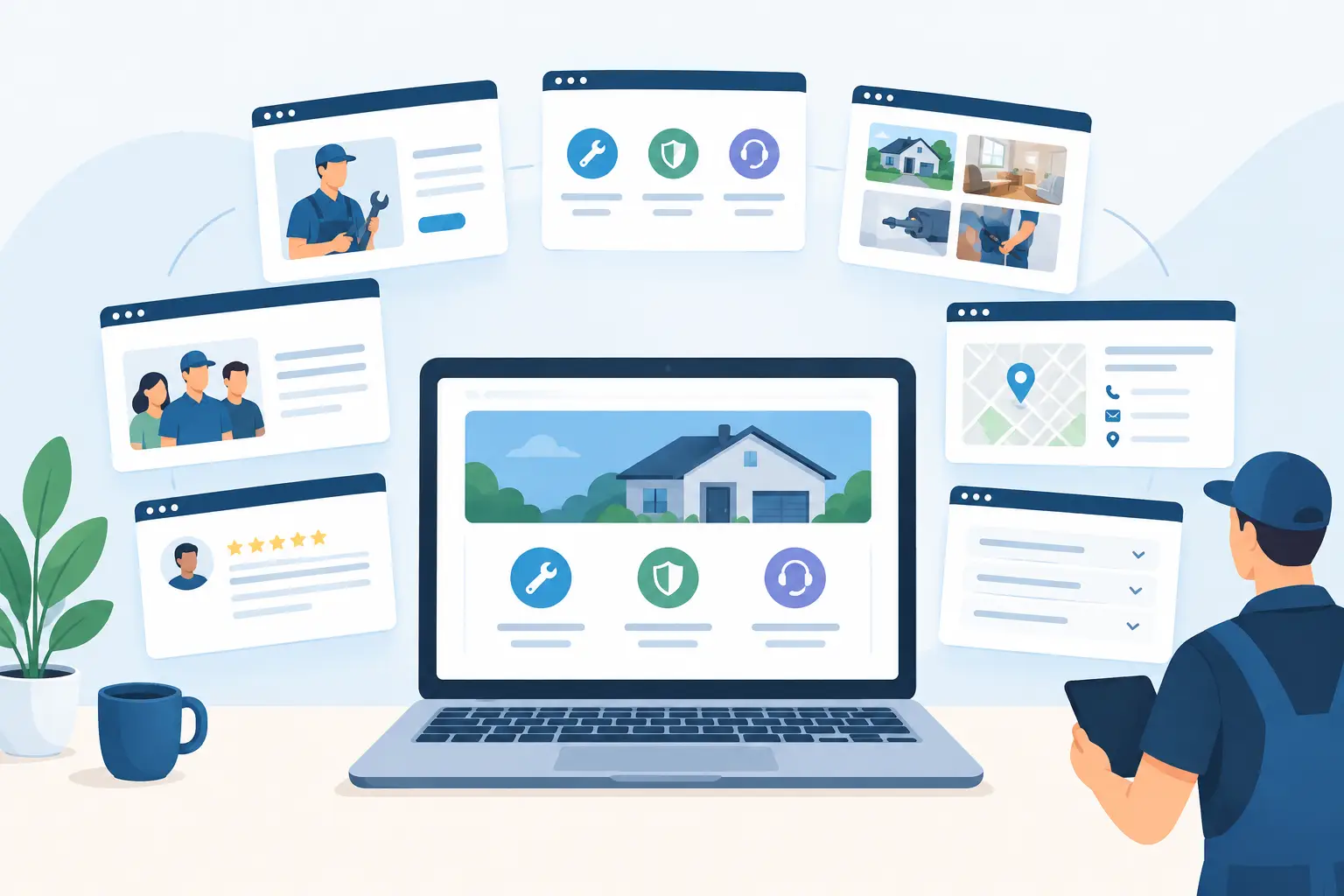
A potential customer has found your business, probably on their mobile phone, and is deciding whether to get in touch. The essential pages for service businesses give them the answers they need before they move on to a competitor: what you do, where you work, why you are credible and how to contact you.
For local businesses in Fareham and across Hampshire, a website does not need dozens of pages to make an impact. It does need the right pages, written clearly and arranged around real customer questions. A polished site should turn interest into enquiries, rather than leave visitors hunting for basic information.
The essential pages for service businesses
The right page structure depends on the service, the length of the buying decision and the areas you cover. A local electrician and a commercial consultant will not need identical websites. However, the nine pages below provide a strong, practical foundation for most service-led businesses.
1. A home page with a clear purpose
Your home page should explain your offer within seconds. Visitors should immediately see what you do, who you help and the area you serve. “Professional cleaning services” is vague; “Reliable domestic and office cleaning across Fareham and Portsmouth” gives people far more confidence.
This page is also where you set the tone for your business. Use a concise introduction, a clear call to action and supporting proof such as reviews, qualifications, years of experience or recognisable client sectors. It is not a place to tell your entire company story. Its job is to direct people towards a service page, a phone call or an enquiry form.
2. A services overview page
If you offer more than one service, give each one a clear route from a central services page. This helps visitors understand the scope of your business without reading through a long home page.
Keep descriptions brief but useful. State what each service includes, who it is for and the outcome customers can expect. A landscaping firm, for example, may separate garden design, regular maintenance and patio installation. A visitor looking specifically for one of those services should not have to guess whether you provide it.
3. Dedicated pages for your main services
A separate page for each important service is often one of the best investments a business can make. It gives you space to describe the work properly, answer common objections and appear in relevant local searches.
Each page should cover the practical details: the problem you solve, what the service involves, what affects the price and what happens next. Include original photographs where possible. Stock imagery can look tidy, but pictures of your team, completed work or local projects do more to show that you are a genuine, established business.
Not every minor add-on needs its own page. If a service is rarely requested or closely tied to another offer, it may be better included as a section on a larger service page. The goal is clarity, not page count for its own sake.
4. An about page that proves there are real people behind the business
Customers of service businesses are often choosing who to let into their home, who to trust with an important project or who to rely on during a stressful problem. Your about page should make that choice feel safer.
Explain how the business started, who leads it and what standards guide the work. Mention relevant experience, training, accreditations and local knowledge, but avoid turning the page into a CV. Plain language works best: tell people why you care about doing a good job and what they can expect when dealing with you.
For a small business, a photograph and a short introduction to the owner or team can be more persuasive than generic claims about excellent customer service.
5. A service area page
A Fareham business can serve nearby towns and villages without pretending to be a national company. A dedicated service area page makes this clear and helps local visitors see that you are available to them.
List the locations you genuinely cover and explain any practical limits, such as a call-out radius or different availability for larger projects. You can mention Fareham, Portsmouth, Gosport, Southampton and surrounding Hampshire areas where appropriate, but only where it reflects your actual service area.
Businesses with several distinct locations may benefit from individual location pages. That approach works when each page has genuinely useful local information, customer examples or a different service arrangement. Repeating the same paragraph while swapping place names is unhelpful for visitors and weakens the quality of the site.
6. A testimonials or case studies page
A good review reduces risk. It tells a prospective customer that other people had the same concern, hired you and were pleased with the result. Short testimonials can appear throughout a website, but a dedicated proof page gives your strongest feedback a permanent home.
For higher-value or more involved services, case studies are even better. Show the starting problem, the work completed and the result. A before-and-after gallery is effective for trades, beauty, cleaning, landscaping, renovation and many other visual services. For professional services, a short account of the challenge and solution can be more appropriate.
Use real feedback, with permission, and include enough context to make it believable. “Fantastic service” is welcome, but “Our Fareham office move was completed over a weekend with no disruption on Monday” carries greater weight.
7. A process and pricing page
Uncertainty stops enquiries. Customers may not expect an exact price online, particularly for bespoke work, but they do want to know how your business operates.
A process page can explain what happens after someone contacts you: an initial conversation, site visit, quotation, booking, delivery and aftercare. This is especially useful where projects have several stages or customers need to prepare before work begins.
Where possible, offer price guidance. You might show starting prices, package options, hourly rates or the factors that shape a quotation. There is a trade-off here. Publishing fixed prices can save time by filtering unsuitable enquiries, while a quote-only approach may suit complex work where every job varies. Either way, be clear. Hidden costs and vague promises are rarely good for trust.
8. A helpful frequently asked questions page
An FAQ page is valuable when customers repeatedly ask the same practical questions. Think beyond broad questions such as “What services do you offer?” and answer the points that influence a booking: Are you insured? Do you offer evening appointments? How quickly can you attend? What payment methods do you accept? Do I need to be present?
Keep answers concise and honest. If something depends on the job, say so and explain what determines it. FAQs should support the decision to enquire, not replace a conversation where professional advice is needed.
If you only have two or three common questions, place them on the relevant service page instead. A separate FAQ page earns its place when it saves customers time and reduces repetitive calls.
9. A contact page built for action
The contact page is where interest becomes an enquiry, so make it uncomplicated. Include your telephone number, email address, business hours and service area. A simple contact form is useful for customers who cannot call during working hours, especially on a mobile phone.
Ask only for the information you need to respond properly. Name, contact details, location and a short description of the work will often be enough. A form with too many required fields can feel like a chore before the customer has even spoken to you.
If you operate from premises that customers visit, include clear address details and parking or access information. If you are mobile or work by appointment only, say that clearly to prevent confusion.
Make every page work together
A credible website is not a digital brochure that sits quietly in the background. Each page should lead naturally to the next step, whether that is learning more about a service, viewing previous work or requesting a quote. Consistent branding, readable text, mobile-ready layouts and clear contact options matter as much as the words on the page.
Technical basics also affect trust. Visitors expect pages to load quickly, forms to work and the site to display properly on a mobile phone. Ongoing updates, secure hosting and regular maintenance help protect the investment you have made in your online presence.
Jawbone Media builds custom WordPress websites for Fareham businesses that need these foundations handled properly, without having to manage domains, hosting, branded email or technical updates themselves. The most effective starting point is not adding every possible feature. It is deciding what your next customer needs to know, then making that answer easy to find.
Leave a Reply