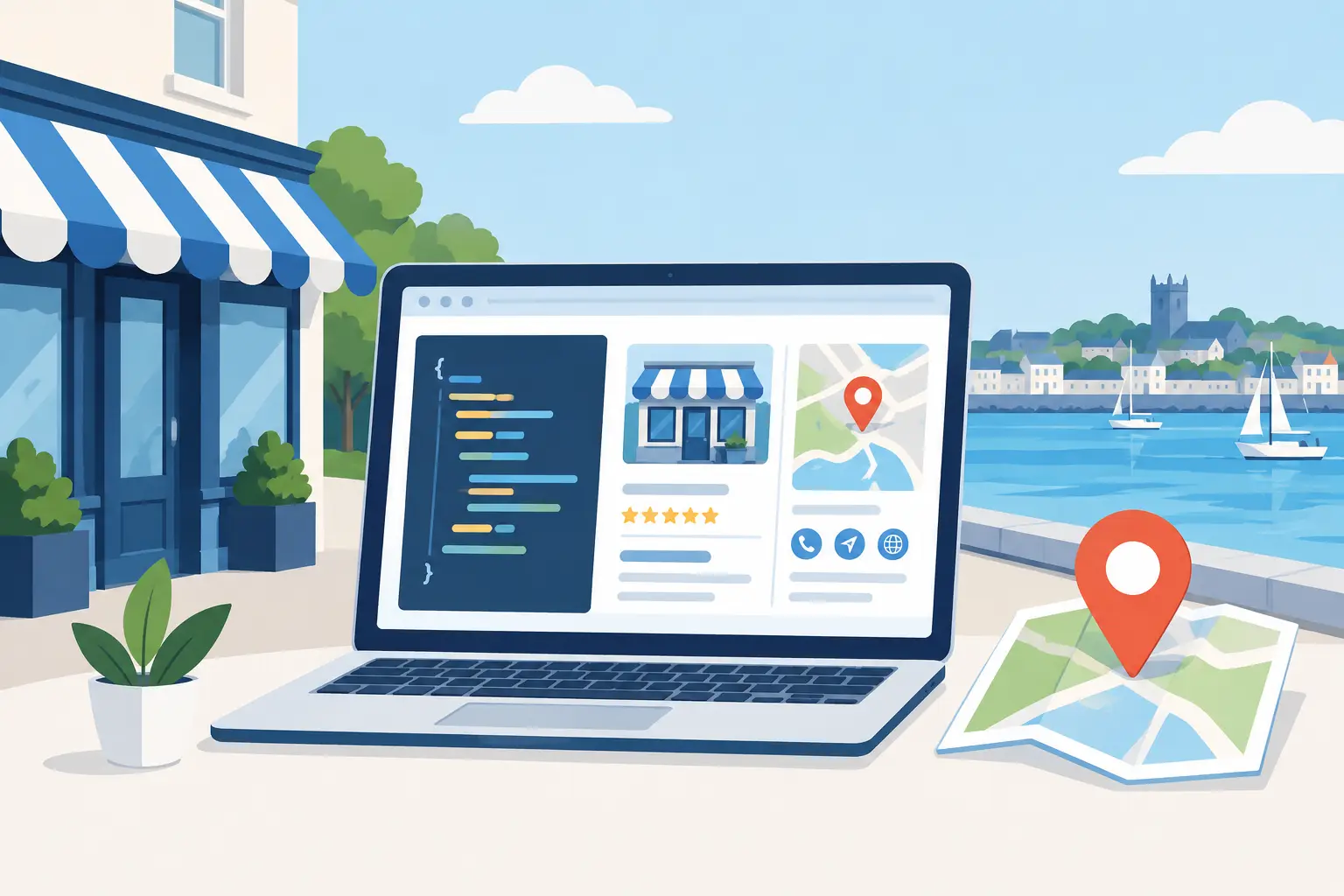
A potential customer searches for a Fareham electrician, café, solicitor or web designer and sees several similar-looking results. Your website may already be well designed, mobile-friendly and accurate, but search engines still need help interpreting the details behind the page. This local business schema markup guide explains how to provide that help without turning your website into a technical project.
Schema markup is not a shortcut to the top of Google. It is structured information added behind the scenes so search engines can more confidently identify your business name, address, phone number, services, opening hours and other useful facts. For local businesses, that clarity can support a more consistent presence in search and make it easier for customers to find the right information.
What local business schema markup does
Schema markup is code that describes the content on a webpage in a standard format. LocalBusiness is the broad schema type used for businesses that serve customers from a physical location or within a defined local area. More specific types exist too, such as Restaurant, Dentist, LegalService, AutoRepair and HomeAndConstructionBusiness.
Think of it as a clear business card for search engines. A visitor can usually recognise your company name and opening times from a page layout. A search engine has to interpret headings, paragraphs, menus and images. Structured data reduces the guesswork.
Used properly, local schema can reinforce information that already appears visibly on your site. It should not be used to make claims that are absent from the page, to add false reviews, or to suggest an office in a town where you do not genuinely operate. Accuracy matters more than adding every possible field.
Why it matters for Fareham businesses
Local searches are usually practical and time-sensitive. Someone looking for a plumber in Fareham may need to call today. Someone comparing accountants, builders or beauty clinics may want to check opening times, service areas and reviews before making an enquiry. If the essential business information is clear and consistent, you remove friction at precisely the point a customer is ready to act.
Schema is only one part of local visibility. A credible website, well-maintained Google Business Profile, accurate directory listings, useful location-focused content and genuine customer reviews all work together. The trade-off is simple: markup can strengthen a sound local presence, but it cannot compensate for thin content, inconsistent contact details or a slow, outdated website.
For companies serving Fareham, Gosport, Portsmouth, Southampton or the wider Hampshire area, service area information needs particular care. Use your genuine base address where customers can visit you. If you travel to customers instead, describe the areas you serve without presenting each area as a separate staffed office.
The core details your markup should include
A good local business schema setup starts with the basics customers expect to find. Your legal or trading name, telephone number, website address, logo, postal address and opening hours should match the information displayed on your contact page and Google Business Profile.
Add a concise description of what you do, rather than a string of repeated local keywords. A Fareham roofing company could state that it provides domestic roof repairs, replacements and guttering services across Hampshire. This is clearer for customers and more useful for search engines than repeating “best roofer Fareham” several times.
Where relevant, include your price range, accepted payment methods and social profile references. Do not guess at fields you cannot support. If your opening hours change seasonally, during bank holidays or by appointment, reflect that honestly on the website first and then in the structured data.
Choose the most specific business type
LocalBusiness is a sensible starting point, but a more precise type is usually better when one genuinely fits. A restaurant should use Restaurant. A local estate agent may use RealEstateAgent. A professional service could use ProfessionalService or a more specific category where available.
There is no value in forcing a label that does not describe the business. A multi-service company may need the broader LocalBusiness type alongside clear service pages, rather than trying to classify itself as several unrelated business types on one page.
Use JSON-LD rather than altering page layout
For most WordPress websites, JSON-LD is the practical format. It sits in the page code and does not change how the page looks to visitors. It can be added through a suitable SEO or schema tool, a carefully managed code snippet, or as part of your website development and maintenance service.
The technical method matters less than the ongoing process. If you change your phone number, move premises or alter opening hours, the visible site content, structured data and business listings should all be updated together.
A practical local business schema markup guide
Start by reviewing the public information customers see. Check your homepage, contact page, footer and Google Business Profile. Write down the exact version of your name, address and telephone number that should be used everywhere. Even small inconsistencies, such as “Ltd” appearing in one place but not another, can create avoidable confusion.
Next, decide which page should carry your primary business markup. For a single-location business, this is often the homepage or contact page. The page should clearly show the same business details included in the code. If you have separate, genuine branches with their own addresses and opening hours, each location should have its own relevant page and markup.
Then add the supporting properties that reflect your real operation. Include a description, opening hours, logo and service area where appropriate. If you offer online booking, use the actual booking page. If customers can contact you through a form, make sure the form works properly on mobile devices and sends enquiries to a monitored inbox.
Finally, test the markup before treating the job as complete. Testing can reveal missing required fields, incorrect formatting and warnings that need a judgement call. Not every warning is a serious problem, but errors should be addressed. Keep a record of where the code has been added so it is not accidentally duplicated during a future website update.
Common mistakes that reduce its value
The most common problem is inconsistency. A company may have an old address in its website footer, a different number on Facebook and a new trading name on its Google Business Profile. Schema markup cannot solve this on its own. It will only repeat the uncertainty.
Another issue is adding review or rating schema that does not meet search engine guidelines. Reviews need to be genuine, visible where required and connected to the right business or service. Manufactured ratings risk losing trust and can create a compliance problem.
Businesses also sometimes create dozens of near-identical area pages and attach local schema to each one. If the company has no actual presence in those places and the pages add little useful information, this can look unhelpful to both search engines and visitors. It is generally better to build a small number of useful service pages that explain the work you do, your coverage area and how customers can get in touch.
Does every small business need schema?
Not every business needs a complex schema programme. A sole trader with a simple brochure site can benefit from accurate LocalBusiness markup, but does not need to add every optional property. The priority should be a polished, secure website with clear services, contact details and a straightforward route to enquiry.
Businesses with multiple locations, appointment systems, menus, events, products or detailed service pages may have more opportunities to use additional schema types. In those cases, the markup needs more planning because duplicated or contradictory code becomes easier to introduce.
For many Hampshire businesses, the sensible approach is to set up the core business information correctly at launch, test it, and review it whenever the website changes. Jawbone Media can incorporate this kind of practical search-readiness work into a tailored WordPress website, without leaving you to manage technical code alone.
Keep schema aligned with your business
Local business schema works best as part of routine website care, not as a one-off SEO task. Review it after a move, rebrand, change of phone number, new opening hours or expansion into new services. Check that your mobile contact options still work and that customers can find the answer they need without hunting through the site.
The useful question is not “How much markup can we add?” It is “What information would help a local customer choose us with confidence?” Keep that information accurate, visible and easy to maintain, and your website will give both search engines and prospective customers a clearer reason to trust it.
Leave a Reply